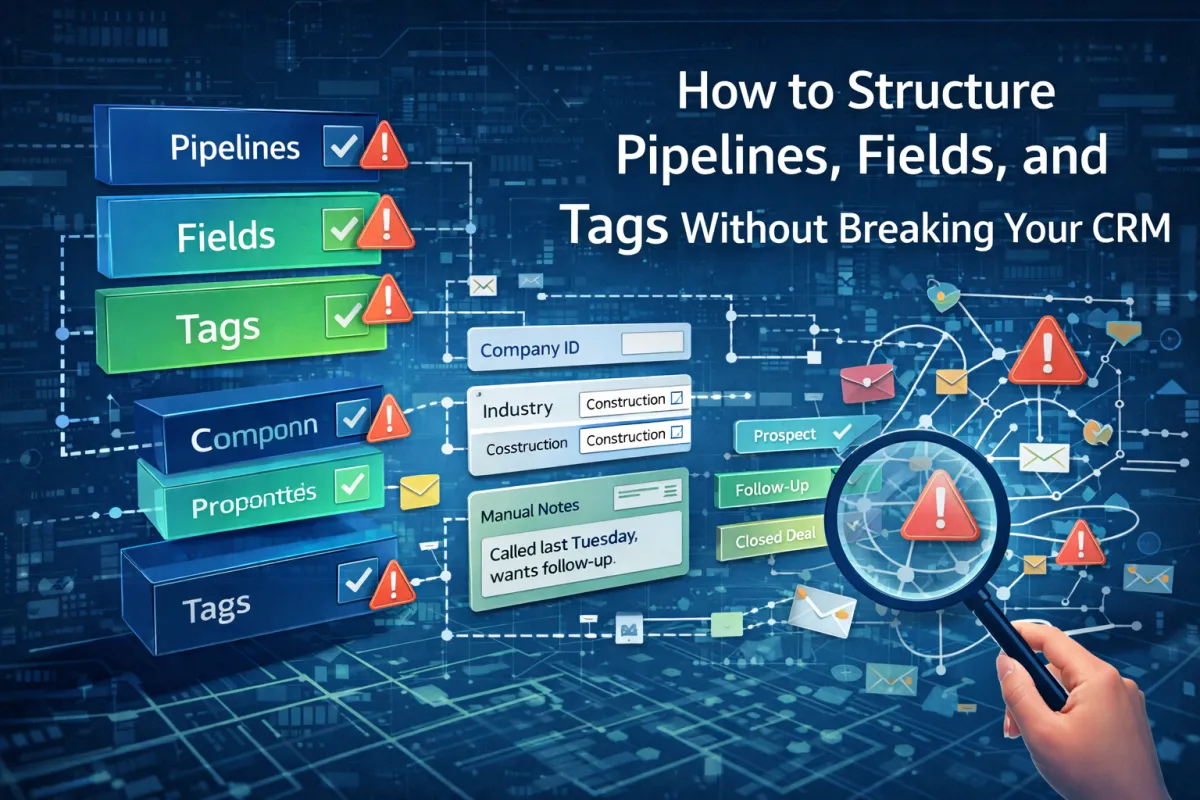
How to Structure Pipelines, Fields, and Tags Without Breaking Your CRM
The Hidden Cost of “Just One More Field”
Every CRM eventually reaches a breaking point.
Not because of volume, but because of uncontrolled complexity.
Pipelines, fields, and tags are the core building blocks of CRM structure. When misused, they create confusion that automation cannot fix.
Pipelines: Represent Progress, Nothing Else
Pipelines should answer one question only:
Where is this opportunity right now?
Best practices:
One primary pipeline per business model
Stages tied to objective events
No emotional or subjective labels
In automation-capable CRMs like GoHighLevel, pipelines are often used as triggers. This makes accuracy non-negotiable.
Fields: Store Facts, Not Interpretations
Fields exist to store data, not opinions.
Good fields:
Have a single purpose
Are clearly named
Are consistently populated
Bad fields:
Duplicate existing data
Store temporary notes
Exist “just in case”
Best practice is auditing fields regularly and removing anything unused.
Tags: Context, Not Control
Tags are powerful but frequently abused.
Correct tag usage:
Source context
Special conditions
Temporary states
Incorrect usage:
Deal stages
Ownership tracking
Lifecycle control
When tags are used to control logic instead of describe context, systems become fragile.
Avoiding Overlapping Logic
One of the most dangerous CRM patterns is overlapping logic:
A pipeline stage triggers a workflow
A tag triggers a second workflow
A field update triggers a third
Best practice architecture ensures:
One trigger per outcome
Clear priority rules
No circular automation
This keeps systems predictable and debuggable.
Naming Conventions Are Not Optional
Inconsistent naming creates confusion at scale.
Best practices include:
Standard prefixes for fields
Clear, human-readable labels
Documentation for complex logic
Good naming reduces onboarding time and prevents accidental misuse.
Designing for Reporting From Day One
Reporting depends entirely on structure.
Best practices:
Pipelines reflect conversion stages
Fields store measurable data
Tags are excluded from core metrics
If reporting feels unreliable, the issue is almost always structural.
Change Management Matters More Than Setup
CRMs don’t fail on day one. They fail over time.
Best practice includes:
Documenting changes
Testing before deployment
Periodic structural audits
Platforms like GoHighLevel evolve quickly. Without discipline, systems degrade just as fast.
Why Acquire One Builds With Restraint
Acquire One intentionally limits:
Number of pipelines
Number of fields
Number of active workflows
This restraint creates systems that are easier to operate, maintain, and scale.
Final Thought
A CRM is not powerful because it can do everything.
It’s powerful because it does the right things consistently.
Structure protects that consistency.
