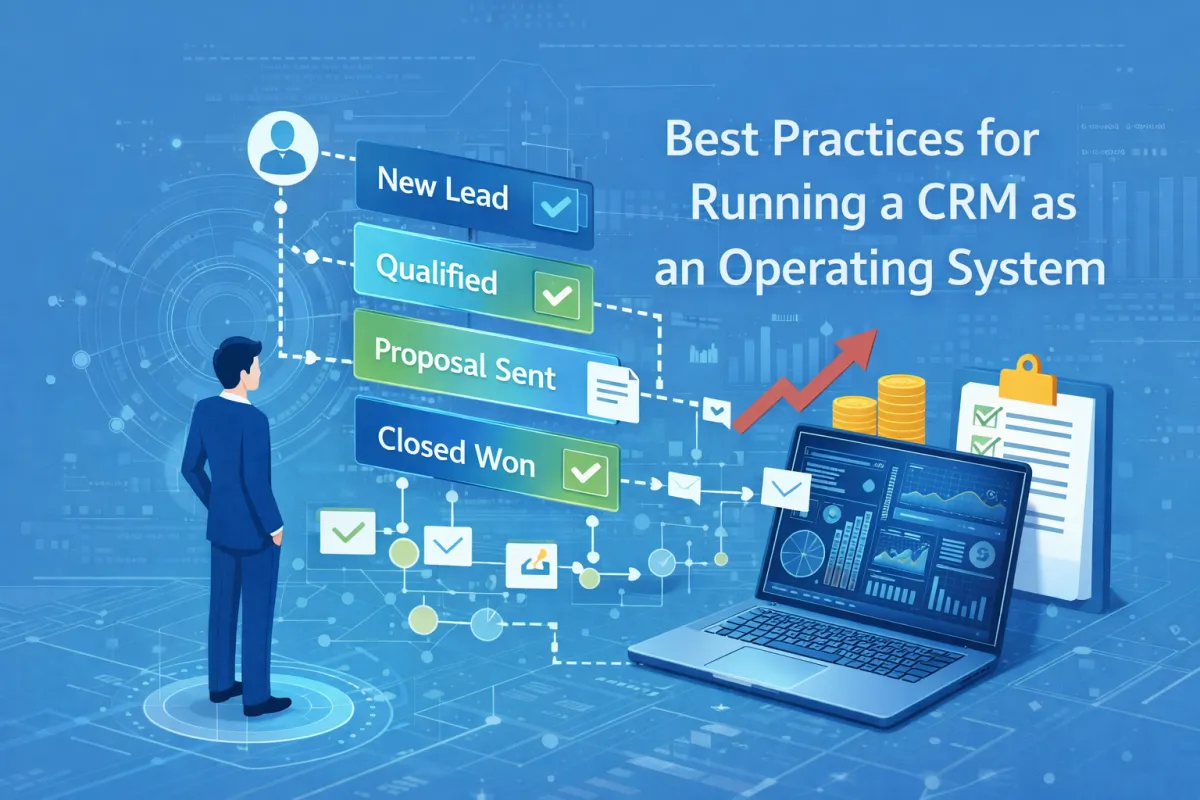
Best Practices for Running a CRM as an Operating System
Why CRM Usage Matters More Than CRM Features
Most businesses don’t fail because their CRM lacks features.
They fail because the CRM is not treated as an operating system.
A CRM operating system governs:
How leads enter the business
How work is assigned
How decisions are made
How performance is measured
When used casually, even powerful platforms degrade into expensive address books. Best practices exist to prevent that outcome.
Rule 1: The CRM Is the Default, Not the Backup
In high-performing teams, the CRM is not optional.
If something is not in the CRM:
It did not happen
It cannot be trusted
It cannot be reported on
Modern CRM platforms like GoHighLevel allow communication, tasks, notes, and activity tracking to live in one place. Best practice is enforcing that all deal-related activity lives inside the system, not in side conversations.
Rule 2: Pipelines Are for Truth, Not Optimism
Pipeline stages must reflect reality, not intention.
Best practice pipelines:
Move forward only when a verifiable action occurs
Never skip stages without justification
Are updated in real time, not at the end of the week
When pipelines are used correctly, they become a real-time health indicator of the business.
Rule 3: Automation Supports Behavior, It Doesn’t Replace It
Automation exists to:
Remove repetitive tasks
Enforce consistency
Reduce human error
It should never replace judgment or accountability.
In platforms like GoHighLevel, workflows can:
Trigger follow-ups
Assign tasks
Escalate inactivity
But best practice is designing automation to support human action, not bypass it.
Rule 4: Keep Data Inputs Minimal and Mandatory
Every field added to a CRM is a tax on behavior.
Best practices include:
Fewer fields, clearly named
Mandatory fields only when required
No optional “nice-to-have” data
If data is not used for routing, reporting, or decision-making, it should not exist.
Rule 5: Separate Lifecycle From Activity
One of the most common CRM mistakes is mixing lifecycle status with engagement activity.
Best practice separation:
Lifecycle stages show where the lead is in the business journey
Activity logs show what happened
Notes explain context
This separation keeps reporting clean and prevents logic conflicts in automation.
Rule 6: Design for Exceptions, Not Just Happy Paths
Real businesses are messy.
Best practices account for:
No-shows
Unresponsive leads
Reopened opportunities
Lost deals returning months later
A well-run CRM includes clear rules for exceptions instead of relying on manual fixes.
Rule 7: Limit Who Can Change Structure
CRMs decay when everyone has edit access.
Best practice governance includes:
Restricted permissions for pipelines and fields
Controlled workflow deployment
Change documentation
This protects the system from gradual chaos.
Why Acquire One Emphasizes Operational Discipline
Acquire One treats CRM platforms as operational infrastructure, not software subscriptions.
Best practices are enforced because:
Consistency scales
Discipline reduces support issues
Structure protects automation
Final Thought
A CRM becomes powerful when it stops being flexible.
Rigidity is not a flaw.
It’s what allows growth without collapse.
